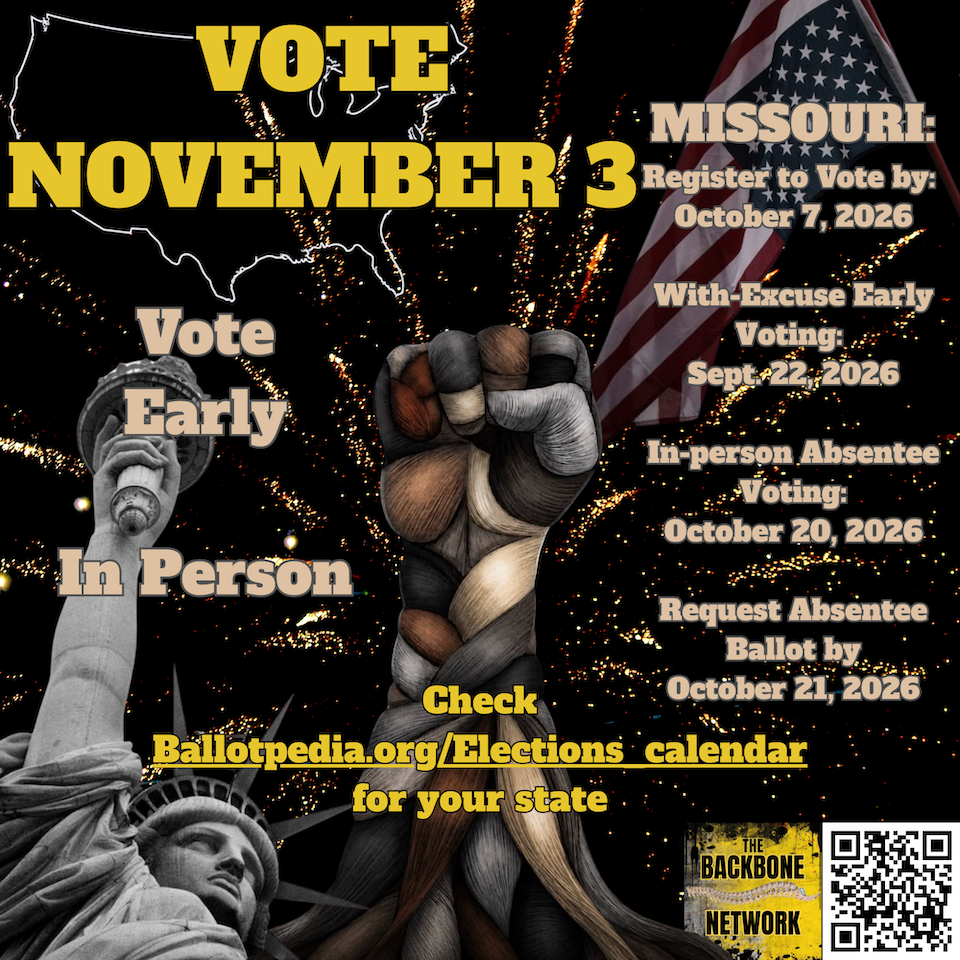
With ballots already in the mail in North Carolina and more states about to follow, the Supreme Court is being asked to change the federal rules governing mail ballots while voting is already underway. That is not speculation. It is the literal, current status of an emergency case before the Court this week—and it is exactly why voting early, in person if you possibly can, matters more this cycle than almost any other.
We talk about “Election Day” as though democracy happens on a single Tuesday. It does not. Ballots are already printed, mailed, and being processed weeks before November 3. When the rules change in the middle of that process, voters are the ones who pay for it—particularly rural voters waiting on a ballot, older voters who cannot easily get to a polling place, disabled voters relying on accessible options, and service members voting from within the United States.
What’s actually happening
†rump signed an executive order in March 2026 directing the Department of Hømeland Seçurity to compile citizenship lists and pushing the U.S. Postal Service toward a gatekeeping role over who receives a mail ballot at all. The Postal Service then issued a 95-page final rule requiring election officials to submit ballot-envelope designs and voter data —including names, addresses, and a new tracking barcode— into a federal portal and obtain advance USPS approval before ballots can even be mailed.
A coalition of 23 states and Washington, D.C., sued. U.S. District Judge Indira Talwani has blocked key provisions of the rule, most recently with a preliminary injunction on September 4, finding the rule likely unconstitutional and warning that forcing it through on the record before her would make voter disenfranchisement “practically inevitable.” Her ruling noted something worth sitting with: the government’s own filing contained no evidence of the mail-ballot fraud it claims this rule is meant to stop.
The †rump regime did not accept that. Over Labor Day weekend, the Department of Justice went back to the Supreme Court asking it to lift the injunction immediately. The government argued that because North Carolina and Alabama had already begun mailing ballots, and more states follow the week of September 13, the Court needed to act before “those ballot envelopes enter the mailstream.”
Justice Ketanji Brown Jackson, who oversees the First Circuit, declined to grant the emergency request outright and instead ordered responses filed this week. That means the fight over federal rules affecting whether mail ballots can be sent through the Postal Service remains unresolved even as ballots are already going out.
This is not the first time the Court has weighed in. In August, a 6–3 decision along ideological lines let other parts of †rump’s order take effect, including the DH$ citizenship-list compilation and the Attorney General’s authority to prioritize prosecuting state election officials. Justice Sotomayor, joined by Justice Kagan, dissented. Justice Jackson wrote separately to accuse her conservative colleagues of, in her words, deepening electoral confusion on the eve of voting.
Election-law scholar Rick Hasen, who has studied election cases for more than 30 years, did not mince words:
“I have never in over thirty years of teaching and studying election cases ever seen an attempt like this one to roll out a major change in election administration against the will of state and local election officials on a time frame that is certain to impede on states’ ability to run elections and that will certainly disenfranchise thousands if not millions of voters.”
Hasen was clear that this is not merely a partisan risk. It threatens voters “across the political spectrum and in red and blue states.”
Why this could disrupt ballots
The danger is not limited to a single voter being rejected. A matching system can produce errors for ordinary, lawful reasons: a voter moved; a newly married voter changed their last name; an address appears in a different format; or a local record did not update in time.
The concern described by voting-rights lawyers is that a rushed federal verification system can turn routine record discrepancies into barriers for eligible voters. Depending on how the system is administered, one bad match or data error can disrupt ballot mailings far beyond the individual voter whose record triggered the mismatch.
That is exactly why a new, federally imposed verification system should not be forced on states after ballots have begun going out. Election administration requires accuracy, testing, notice, and time. Voters should not lose access to a ballot because a database cannot recognize a common address change or a new last name.
Even the people running the system are worried
This is not only a legal fight between lawyers. ProPublica reported that Postal Service officials themselves raised internal concerns while drafting these rules about the risk of delaying or blocking ballots for large numbers of eligible voters.
A separate whistleblower disclosure to Sen. Richard Blumenthal warned that the new verification portal is untested, error-prone, and being run on what the whistleblower called a “zero-percent failure policy,” despite every complex system having a known error rate. The disclosure also alleged that the †rump regime moved forward building parts of the system even while it was under an active court injunction.
The government may call that administrative reform. But when an untested system is imposed during an active election, the people bearing the risk are not the officials who designed it. They are the voters whose ballots may arrive late, be blocked, be lost in a procedural dispute, or be rejected after it is too late to fix the problem.
Why this means vote early
If you can vote early in person, do it. It is the most direct way to remove your ballot from a mail system caught between a federal court injunction and an emergency Supreme Court appeal.
That does not mean mail voting is unsafe or that people who rely on it should stay home. Mail voting remains legal and essential for many people: disabled voters, older voters, rural voters, students, service members, caregivers, and workers with inflexible schedules. If voting by mail is your best or only option, use it—but start early.
Request your ballot as soon as your state allows. Complete it carefully. Return it as soon as possible. When permitted, use an official drop box or hand-deliver it to your local election office instead of trusting the final mail pickup before a deadline. Then track the ballot through your local election office or, where available, BallotTrax.
Voting early buys you something Election Day cannot: time.
Time to discover that a ballot never arrived.
Time to fix a registration problem.
Time to cure a signature issue where your state allows it.
Time to get a replacement ballot.
Time to adjust if you get sick, your car breaks down, work runs late, bad weather hits, or your polling place has an hours-long line.
Waiting until the last minute means betting that every part of the chain —the mail, the rules, the polling place, your health, your schedule— will hold up perfectly. That is a bad bet to make with your vote.
Mail voters should be especially careful about deadlines. States differ on whether a ballot must be received by Election Day or merely postmarked by Election Day. They also differ on whether ballot drop boxes or signature-cure periods are available.
Do not assume that putting a ballot in the mail at the last minute means it will be counted. A ballot placed in a mailbox or dropped at a post office late in the day may not receive a postmark that same day. If postmarks matter in your state, ask your local election office or postal clerk about the safest way to document timely mailing. Bring your ballot to a retail post-office counter early enough to ask for a hand-applied postmark, and keep any receipt or proof of mailing that is available. Then check your ballot’s status through your local election office.
Voting early is not only self-protective. It helps everyone else too. When people vote early, Election Day lines shorten, poll workers have more time to help voters who need assistance, and election offices have more room to catch and fix problems.
Voter suppression works through delay, confusion, and exhaustion. It depends on people giving up, running out of time, believing a false rumor, or assuming they can always come back later. A voter who has already cast their ballot does not have to be talked out of voting by a long line, a sudden emergency, a late court ruling, or a change in procedure.
No one should have to guess in September whether the federal rules affecting ballot mail will remain stable through November. But while this legal fight continues, the safest vote is the one you cast as early as you can.
Resources to use before November 3
Two openly Democratic tools are worth using too: BlueVoterGuide.org, a free, volunteer-built tool that shows your full ballot, including the down-ballot races many people skip, with endorsements from progressive organizations; and IWillVote.com, the Democratic Party’s voter-information hub for registration, mail ballots, and polling locations in all 50 states.
Election Protection is a nonpartisan voter-assistance project run by the Lawyers’ Committee for Civil Rights Under Law. Call if you have a problem with registration, ID requirements, an inaccessible polling place, a rejected mail ballot, voter intimidation, or trouble voting:
- English: 866-OUR-VOTE — 866-687-8683
- Spanish: 888-VE-Y-VOTA — 888-839-8682
- Asian-language assistance: 888-API-VOTE — 888-274-8683
- Arabic-language assistance: 844-YALLA-US — 844-925-5287
- Disability Rights Hotline: 888-796-VOTE — 888-796-8683
Check your voter-registration status through any of these free, nonpartisan tools:
- Vote.org
- Rock the Vote
- VOTE411, operated by the League of Women Voters
All three work in every state. After checking online, confirm your registration, ballot deadline, early-voting site, and local rules through your official state or county election office.
BallotTrax is a ballot-tracking service that can text, email, or call you when a mail ballot is sent, received, and accepted. It is only available where your state or county has signed on, so check whether your jurisdiction participates.
Vote early. Protect your vote.
Voting early is not panic. It is preparation.
It means casting your ballot before a mail delay, a database error, a late postmark, a court ruling, a long line, illness, work, weather, or an Election Day emergency gets the chance to decide whether your voice is heard.
This year, that preparation matters even more. Ballots are already moving. The legal fight is still moving. Do not leave your vote caught between them.
Vote early. Follow your local election office’s instructions. Track your ballot. Make sure it is received and counted. You may visit Vote.org’s calendar to find out your state’s early voting dates.
#Midterms #VoteEarly #VoteBlue #FDT #ElectionIntegrity #VoterRegistration #DontWaitTilNov #RockTheVote #VotingProtection #LeagueOfWomenVoters
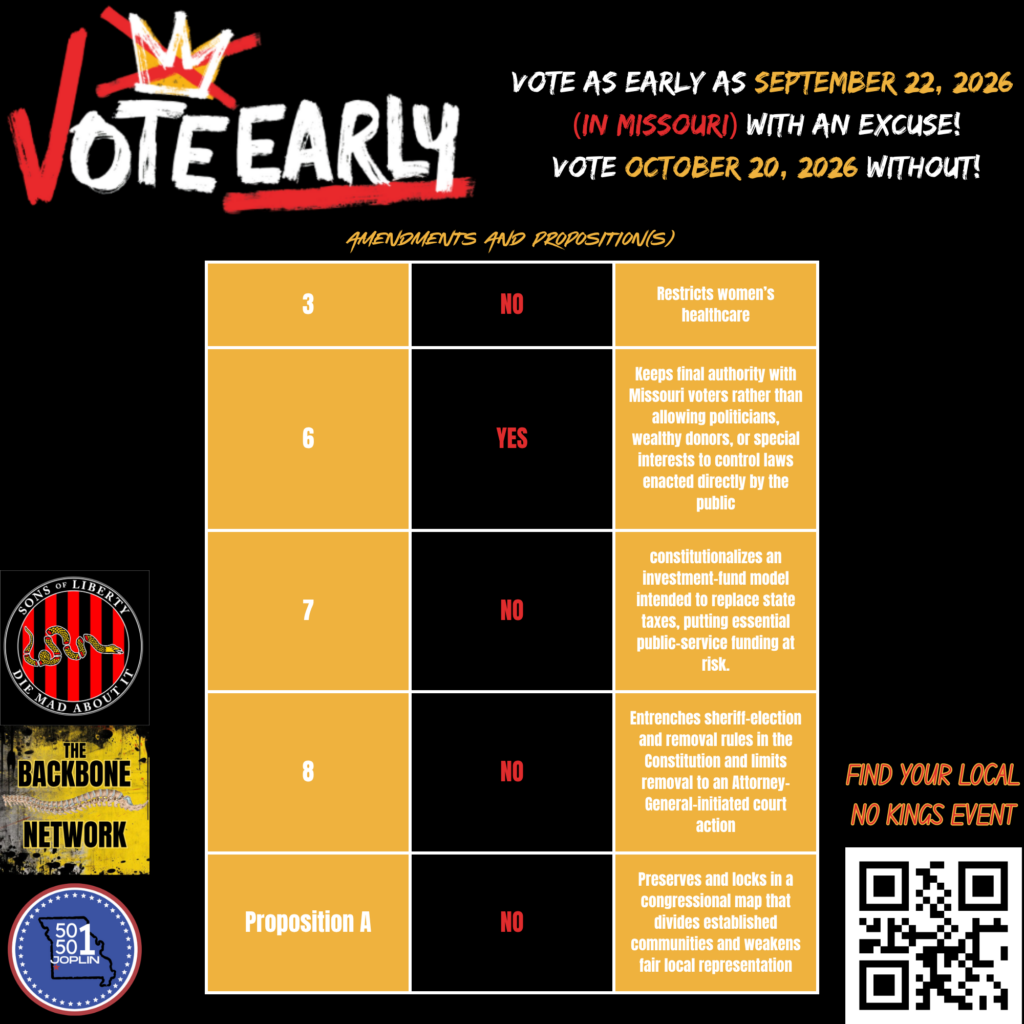
Read the following for more about the Missouri ballot:
Missouri’s 2026 Ballot: Vote NO on Amendments 3, 7, and 8 – And proposition a
AUG 19; UPDATED 9/8
Missouri voters will decide three statewide constitutional amendments on November 3, 2026: Amendments 3, 7, and 8. The measures address reproductive freedom, state revenue, and local law-enforcement accountability. Amendment 6, a proposed constitutional amendment concerning Missouri’s initiative and referendum process, is also now currently on the ballot.