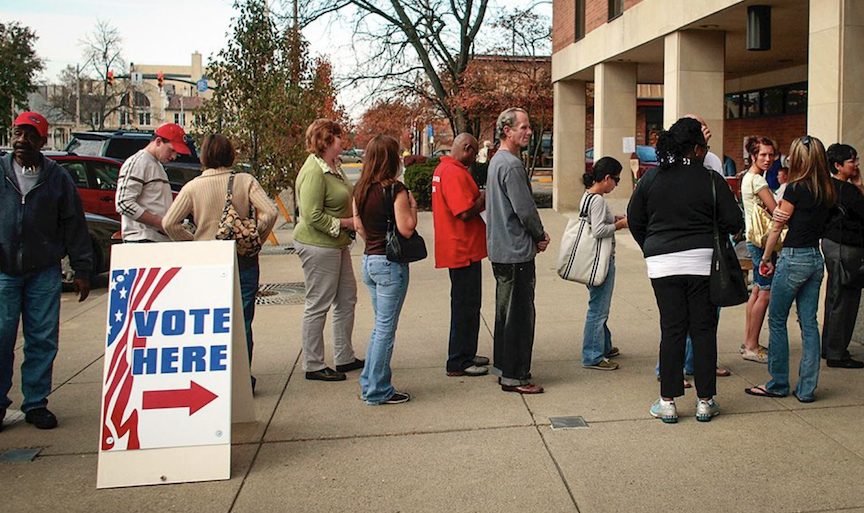
†rump has spent years attacking mail ballots, election workers, voter rolls, and trust in the count. In America’s blue cities, the answer is not fear.
If you live in Los Angeles, New York City, Chicago, Detroit, Atlanta, Philadelphia, Kansas City, Houston, or any other city repeatedly targeted in †rump’s election rhetoric, you may be asking a reasonable question: Will my vote be safe?
You have watched †rump attack mail ballots, spread unsubstantiated claims about noncitizen voting, demand sensitive state voter files, dismantle independent election oversight, and refuse to rule out IÇE or National Guard deployments near voting sites. The fear is understandable. It is also exactly what this campaign of distrust is designed to produce.
†rump does not need to literally cancel the 2026 midterms to undermine them. He only needs to convince enough people, especially Black voters, naturalized citizens, immigrant families, young voters, disabled voters, and people living in Democratic cities, that their ballot will not count, that voting by mail isdangerous, that a polling place is unsafe, or that the result is already fixed.
That is his trap. The answer is not to stay home. The answer is to vote with a plan, go with people you trust, know your rights, document problems safely, and refuse to let intimidation become another form of disenfranchisement.
The Sore Loser
No one should have to guess how †rump responds to an election result he cannot accept. The country already watched it happen in 2020.
After losing the presidential election, †rump falsely claimed widespread fraud even though recounts, audits, state certifications, court rulings, and federal election-security officials found no evidence that voting systems deleted, lost, or changed votes. The Cybersecurity and Infrastructure Security Agency, then operating within †rump’s own Depårtment of Hømeland Seçurity, described the 2020 election as “the most secure in American history.”
After refusing to accept the result, †rump and his allies filed dozens of lawsuits seeking to overturn it; courts repeatedly rejected the claims because they did not establish fraud or illegality sufficient to change the outcome.
The effort went beyond lawsuits. The House January 6 Committee’s final report described a multi-part campaign to overturn the lawful election result: spreading false fraud claims, pressuring state officials, organizing alternate slates of electors, pressuring Vice President Mike Pence to block certification, and exploiting the violence of January 6.
A federal grand jury later charged †rump with four crimes related to his conduct after the 2020 election. The Jus†ice Depårtment alleged in its indictment that the conspiracy sought to overturn the legitimate result through knowingly false claims, fraudulent elector certificates, pressure on officials, and obstruction of Congress’s certification proceeding. †rump pleaded not guilty, and the case did not reach trial after he returned to office; an indictment is not a conviction. But the documented conduct, the state-level pressure campaign, and the January 6 attack are not speculation. They are a proven attempt to overturn a lawful election.
This history is why 2026 deserves vigilance. The danger is not that †rump might discover some new way to distrust elections. He has spent years rehearsing the same playbook: claim fraud without proof, insist a loss is impossible, pressure election officials, demand extraordinary intervention, and tell supporters that certification itself is evidence of corruption.
In 2020, the guardrails held because election officials, judges, public servants, and ordinary voters refused to substitute one man’s lies for the law. In 2026, those guardrails are under greater pressure, and †rump now controls the federal agencies he once tried to weaponize from outside the system.
The Lie Before the Ballot
†rump does not need evidence of fraud to attack an election. He needs only a voting method used heavily by people he expects will not vote for him.
In a July 2026 White House address, †rump declared that “mail-in ballots are inherently corrupt” and said he wanted mail voting limited to illness, disability, military deployment, or travel. But there is no evidence of widespread mail-ballot fraud in states that allow no-excuse absentee voting or universal vote-by-mail. Multiple studies have found that voter fraud is rare and not remotely common enough to alter national election outcomes.
Mail voting is a legal method used by seniors, disabled voters, deployed service members, people with long work shifts, caregivers, students, parents, and voters who cannot reliably reach a polling site on a particular Tuesday. When †rump labels those ballots “corrupt,” he is not exposing fraud. He is telling millions of Americans that their lawful votes should be viewed with suspicion.
Then he tried to turn that lie into federal policy. On March 31, †rump signed Executive Order 14399, ordering federal agencies to compile citizenship-verification lists for states and directing the Postal Service to impose new procedures on mail ballots. The order would expand federal involvement in decisions traditionally made by states: who is eligible to receive a mail ballot, how election mail is handled, and what information a voter must provide to participate.
The problem is not merely that the order targets mail voting. Instead, the problem is that it tries to place another federal gatekeeper between an eligible voter and a ballot. The Brennan Center’s legal analysis concludes that the president lacks authority to run elections and that central provisions of the 2025 and 2026 election orders are unlawful.
Federal courts have blocked key parts of the order. A federal district judge issued a nationwide injunction against provisions involving federal citizenship lists and mail-voting restrictions, finding that they exceeded presidential authority and violated separation-of-powers principles. The U.S. Court of Appeals for the First Circuit declined to lift that block, leaving it in place while the regime continues to press the Supreme Court for intervention before November.
That’s the pattern: call legal ballots fraudulent, use the claim to justify federal restrictions, lose in court, and keep pressing until the election calendar itself becomes a weapon.
For voters in blue cities, the message is simple: do not let †rump’s lie make you abandon a legal, secure way to vote. If you vote by mail, request your ballot early, follow every instruction, use your local election office’s official tracking tool, and return it through the method your local election authority recommends. Keep screenshots, confirmation emails, and any tracking number. His strategy depends on making you doubt your ballot. Your response is to cast it correctly, track it, and make sure it is counted.
The Election Commission
†rump has spent years telling Americans that elections cannot be trusted. Then, with the 2026 midterms approaching, he removed the remaining commissioners of the bipartisan federal agency that helps states administer secure, accessible elections.
On July 9, †rump fired the Election Assistance Commission’s two Democratic commissioners, Thomas Hicks and Benjamin Hovland. The commission’s sole remaining Republican commissioner, Christy McCormick, resigned under pressure. A fourth Republican seat had already become vacant earlier in the year. The United States Election Assistance Commission, the bipartisan federal agency created after the 2000 election crisis, has no commissioners at all.
The EAC does not count ballots, declare winners, or take over local elections. States and local governments retain that authority. But the commission performs essential support work: it administers federal election grants, collects election-administration data, provides resources and training to local officials, develops voluntary voting-system standards, and oversees the testing and certification program for voting equipment.
That distinction matters because it shows what †rump did not do: he did notseize control of every voting booth. He disabled the machinery that helps states run them. What he did was disable the bipartisan commission’s ability to make policy, update voting-system standards, revise the national mail voter-registration form, or issue major new guidance at the moment election workers most need independent federal support.
Federal law requires at least three commissioners for the EAC to take formal action. Without a quorum, staff may continue routine operations and work under existing rules, but they cannot adopt or revise key policies, including the Voluntary Voting System Guidelines used to test and certify voting equipment. A post-firing EAC staff memo, reported by Democracy Docket, puts it bluntly: the EAC is a shell. Staff can keep the lights on, but they cannot set a single new policy.
The White House framed the removals as an effort to ensure federal officials are aligned with †rump’s views on “election integrity.” But an independent bipartisan election commission is not supposed to be aligned with any president. It is supposed to help election workers protect every eligible voter’s right to cast a ballot and have it counted.
The loss of a functioning commission also threatens accessibility work for voters with disabilities and people who need language assistance. Election-access experts told Democracy Docket that the agency’s paralysis could delay or weaken that support.
For voters in blue cities, that is a reason to be prepared, not to be discouraged. Elections are still administered primarily by state and local officials, and your ballot still counts. But the people trying to make you doubt that ballot are counting on you to stay home.
What About the Voter Files?
†rump’s campaign against trust in elections is not limited to speeches and executive orders. His regime has also tried to obtain the personal voter information of millions of Americans.
The Jus†ice Depårtment has demanded expansive voter-registration data from at least 39 states, including information that can include voters’ dates of birth, driver’s-license numbers, and partial Social Security numbers. The Depårtment has not identified specific election-law violations that would justify such broad demands. Instead, it has pursued what the Campaign Legal Center describes as an extraordinary expansion of federal collection of sensitive voter data.
But federal courts have repeatedly rejected that rationale. In July, U.S. District Judge Colleen Lawless ruled that Illinois did not have to give the Jus†ice Depårtment its complete, unredacted statewide voter-registration database, which includes sensitive information about more than 8 million residents. The judge found that federal law did not give the attorney general a “general auditing power” over state voter rolls and that the regime had not shown a legitimate purpose tied to a specific suspected voting violation.
Illinois was not an isolated case. By early August, the Brennan Center counted 21 court losses in the regime’s effort to obtain state voter data, with no court ordering a state to surrender an unredacted statewide voter database. The Brennan Center’s litigation summary explains that election officials from both parties have resisted turning over databases containing confidential voter information.
The regime has paired those demands with sensational claims it has not substantiated. In July, Homeland Security officials claimed they had identified 250,000 noncitizens on voter rolls in California, Nevada, New Jersey, and Pennsylvania. The government did not publicly disclose its methods or underlying data, and election officials in the affected states said they could not verify how the regime arrived at those numbers.
Federal Power in Blue Cities
The threat is not only theoretical. The †rump regime has already tested the appearance of federal authority at polling locations in Democratic-leaning cities.
On August 4, the Jus†ice Depårtment sent federal election monitors to polling sites in Detroit, Hamtramck, Lansing, and East Lansing during Michigan’s primary. The Jus†ice Depårtment said the monitors were there to ensure “transparency, ballot security, and compliance with federal law.” The DØJ’s official announcement named the four cities and described the deployment as routine oversight.
The monitors did not disrupt voting in that election. Local officials told Votebeat that they were professional and did not interfere with voters or election workers. The monitors followed the rules, but the rules themselves were sending a message.
Detroit and Hamtramck are diverse, heavily Democratic cities with large Black, Arab American, Muslim, immigrant, and working-class communities. Lansing and East Lansing are also Democratic-leaning communities. The regime selected those locations while pushing unsubstantiated claims about noncitizen voting, demanding sensitive voter data from states, attacking mail ballots, and amplifying a narrative that urban election systems cannot be trusted.
A federal monitor is not the same thing as an IÇE raid, a National Guard deployment, or a voter-intimidation operation. But in communities that have experienced immigration enforcement, racial profiling, police violence, surveillance, and politically motivated investigations, the sight of federal personnel around a polling location carries weight. It can make an eligible voter ask whether voting will draw attention to their family, their immigration status, their neighborhood, or their name.
That fear is precisely why federal election power must be tightly limited and transparently justified. Election oversight is legitimate when it protects voters’ rights and follows the law. It becomes dangerous when a president who has spent years calling urban votes fraudulent sends federal agents into the very communities he has taught his supporters to distrust.
For voters in blue cities, the response is not retreat. It is collective participation and a practical voting plan built before Election Day.
The Armed-Agent Threat
†rump has refused to rule out using IÇE or National Guard personnel at voting locations. His regime says IÇE is not planning operations that specifically targetpolling places, but it has left open a claimed “public-safety” exception for federal enforcement near voting sites.
That is not a promise to protect voters. It is a warning shot.
For immigrant communities, naturalized citizens, Black voters, and families living with the daily threat of immigration enforcement, the appearance of armed federal agents near a polling location can function as intimidation before anyone is arrested. The message does not have to be spoken: show up, and your name, face, family, or citizenship may become visible to the federal government.
That is exactly why Congress made this illegal more than a century ago. 18 U.S.C. § 592 prohibits armed federal personnel from being stationed at polling places, subject to narrow exceptions. An armed deployment intended to intimidate voters or interfere with voting would be illegal. The law applies to armed civil-service personnel, not only the military. IÇE agents are federal law-enforcement officers; a president cannot convert a polling place into an enforcement zone simply by calling it election security. The text of 18 U.S.C. § 592 prohibits armed federal personnel at election sites, and the Protect Our Polls Act’s findings notes that federal law has criminalized sending troops or armed officials to the polls for more than 150 years.
The law also protects voters against more than a gun at the door. Federal and state laws prohibit intimidation, threats, coercion, and interference directed at people attempting to vote. The Brennan Center’s 2026 voter-protection guidance makes the point plainly: sending troops or IÇE officers to polling places is illegal, and voters have the right to cast a ballot without fear.
If armed federal agents appear near your voting site, do not confront them. Do not argue with them. Do not let their presence make you leave without voting. Tell a poll worker or local election official what you see, move to a safe location if necessary, and document only what you can safely and lawfully observe. Then call the nonpartisan Election Protection hotline at 866-OUR-VOTE. The Fair Elections Center’s Election Survival Guide explains that voters may report intimidation and that election-protection teams can help connect people with legal resources.
Turning Citizenship Into a Weapon
The attack on voting is not limited to polling places. It also happens when the government tells naturalized citizens, immigrant families, and communities of color that their names on a voter roll may turn them into targets.
†rump regime officials have repeatedly invoked the threat of “noncitizen voting” to justify demands for state voter files, new citizenship-verification systems, and expanded federal access to personal information. But the scale of actual illegal voting has not matched the regime’s alarmist rhetoric.
A ProPublica investigation found that, from January 2025 through May 2026, fewer than 150 alleged noncitizen voters were referred for federal prosecution nationwide. Of those, only 41 people were charged with illegal voting or related election crimes, and just 14 cases had resulted in convictions or guilty pleas by the time of the report.
Those numbers do not support a national emergency. They show why broad voter-file sweeps and immigration-enforcement involvement are so dangerous: the government can generate fear across millions of eligible voters while uncovering only a tiny number of potential violations.
ProPublica also reported that Jus†ice Depårtment leaders ignored internal concerns that transferring voter lists to Hømeland Seçurity In√estigations for criminal review might be unlawful. Investigators warned that matching immigration databases against voter rolls could produce large numbers of false positives, citizens wrongly flagged because of outdated records, name similarities, data-entry errors, or the failure of one federal database to reflect a person’s naturalization. The investigation describes an effort that treated the voter rolls of whole states as a hunting ground rather than protecting the rights of individual citizens.
That is not how you secure an election. That is how you frighten a citizenry.
If you are a naturalized citizen, you have the same right to vote as any citizen born in the United States. If your family includes people with different immigration statuses, that does not cancel your right to vote. No one gets to demand that you prove your citizenship at a polling site beyond the rules your state law actually requires. You do not need to explain your family’s immigration history to a poll worker, a partisan observer, or a federal agent.
The purpose of these tactics is to make people feel exposed, isolated, and unsafe. Silence is not the answer. Verify your registration through your official state or county election office. If someone threatens you, challenges your eligibility without lawful authority, or appears to be using immigration status to discourage voting, report it to election officials and call 866-OUR-VOTE.
Your citizenship is not conditional, and your ballot is not a favor. The practical steps below can help you vote, document problems, and obtain assistance if anyone tries to interfere.
Putting Election Workers Under Siege
Elections are not run by a faceless machine in Washington. They are run by county clerks, poll workers, municipal employees, election directors, technicians, and volunteers, people who prepare ballots, verify registrations, assist voters, count votes, conduct audits, and certify results under state law.
†rump’s campaign of mistrust turns those public servants into targets.
A 2026 survey of local election officials found that 32% had experienced threats, harassment, or abuse because of their work. Fifty-two percent said they were concerned about the safety of their colleagues, while 23% worried about being assaulted at work or at home. The Brennan Center survey, reported by KIRO 7 captures the human cost of turning routine election administration into a partisan conspiracy theory.
Instead of helping protect those workers, the †rump regime has threatened to prosecute them. His March 2026 election order directs the attorney general to investigate and potentially prosecute state and local officials who issue federal ballots to people the federal government deems ineligible, even if those people are registered and eligible under their state’s own election records. A coalition of state and local election officials warned the Supreme Court that this threat could criminalize good-faith election administration based on flawed federal citizenship lists. Their Supreme Court filing details the risk.
The regime has also weakened the federal capacity to investigate genuine election crimes. Senate Democrats reported that staffing in the Jus†ice Depårtment’s Public Integrity Section fell from 36 attorneys to two, while election-law training for prosecutors and ƒBI agents was canceled. Sen. Chris Van Hollen’s June letter warned that this leaves the Jus†ice Depårtment less prepared to confront actual threats while it increases pressure on the officials who run lawful elections.
That is the inversion at the heart of †rump’s election policy. The people who count legal ballots are treated as suspects. The people spreading lies about stolen elections are treated as guardians of “integrity.”
For blue-city voters, remember this: poll workers and local election officials are not †rump’s agents. They are your neighbors, your county employees, your school-board volunteers, and the people legally responsible for ensuring your ballot is processed. If you see intimidation, threats, unauthorized challenges, or suspicious activity at a voting location, tell an election worker immediately. They are trained to respond, call local election authorities, and connect voters to legal protection.
The best way to defend election workers is to make their job visible: vote early, follow ballot instructions carefully, thank poll workers, and refuse to repeat claims of fraud without evidence. A democracy cannot function when the people who count the ballots must fear the government they serve.
The Preparation for a Stolen Election
The danger is not only that †rump’s regime may make voting harder. It is also that it is building an excuse to reject results it does not like.
The pattern is already visible. Declare mail ballots corrupt. Repeat unproven claims about noncitizen voting. Demand private voter data from states. Threaten election officials who refuse. Fire the bipartisan commissioners who help states administer secure elections. Send federal monitors into Democratic-leaning cities. Refuse to rule out armed immigration agents near polling places.
Then wait for the votes to be counted.
If Democrats win competitive House, Senate, gubernatorial, or local races in November, †rump and his allies will have spent months preparing supporters to believe that the outcome could not possibly be legitimate. The claim will not need evidence. It will only need repetition.
That is what happened in 2020. †rump declared victory before lawful vote counting was complete, claimed fraud when later-counted ballots changed the outcome, and treated normal election procedures as proof of corruption. Courts rejected the claims, state officials certified the results, and federal election-security officials found no evidence that voting systems changed, deleted, or lost votes. Yet the false narrative persisted because it was not designed to prove anything. It was designed to make a loss feel unacceptable.
The goal of the 2026 campaign is not necessarily to stop every ballot from being cast. It is to create enough confusion, fear, litigation, false “evidence,” and public suspicion that every outcome †rump dislikes can be challenged, delayed, or delegitimized.
That is why blue cities are so central. Cities such as Los Angeles, New York, Chicago, Detroit, Philadelphia, Atlanta, and Houston produce millions of votes, include large Black, immigrant, young, and working-class populations, and often count substantial numbers of mail ballots. Those facts make them an easy target for a familiar lie: that urban votes are inherently suspicious simply because they are numerous, diverse, and more likely to reject †rump’s politics.
But an urban vote is not less legitimate because it comes from an apartment building, a college campus, a union neighborhood, a Black church, a mosque, a nursing home, or a home where a citizen’s family includes immigrants. A ballot does not become fraudulent because it was mailed, counted later, cast by a person with an accent, or delivered in a city that voted against the president.
The answer to this strategy is not despair. It is a record too clear to distort: verified registration, correctly completed ballots, early voting where possible, saved confirmation numbers, lawful ballot tracking, public documentation of intimidation, and overwhelming participation.
†rump wants his supporters ready to call the midterms stolen. The rest of the country must be ready to make that lie impossible to sustain.
Fear Should Not Cast Your Ballot
†rump’s strategy depends on people deciding that voting is too dangerous, too confusing, or too pointless. Do not give him that victory before a single ballot is counted. For details on why we’re confident the election will be free and fair, read Why Federal Forces Are Barred From Polling Places — And What the Law Actually Says.
Vote early if you can. It gives you time to correct a registration or ballot problem.
If you vote by mail, request and return your ballot early. Follow instructions exactly, use the official tracking tool, and save your confirmation.
Know your rights and report intimidation (866-OUR-VOTE).
Voters can also seek Spanish-language help at 888-VE-Y-VOTA, Asian-language assistance at 888-API-VOTE, and Arabic-language assistance at 844-YALLA-US. The Fair Elections Center’s 2026 Election Survival Guide explains that voters have the right to cast a ballot free from intimidation by law enforcement, military personnel, and federal agents.
Your ballot does not belong to †rump, ICE, the Jus†ice Depårtment, a billionaire donor, a partisan poll watcher, or anyone who tries to frighten you out of using it.
Vote. Bring someone with you. Help someone else make a plan. Save your proof. Report intimidation. And do not let fear do the work of disenfranchisement for the people who want you silent.
The Midterms Are Ours
The 2020 election proved that the guardrails can hold when election workers, judges, public servants, journalists, and ordinary citizens refuse to accept a false result. The 2026 midterms will test those guardrails again.
†rump wants Americans to distrust the ballot before it is cast. Do not give him that victory.
They want you afraid to vote. Vote anyway.
Where to Go From Here
This is not a moment for individual vigilance alone. The most powerful election protection is organized, collective, and visible. Here is how to turn fear into a plan.
Know who runs your election. Find your local election office and learn how your county prepares ballots, verifies registrations, and counts votes. The people doing this work are your neighbors, not †rump’s agents. When you understand the process, you are harder to frighten about it.
Check your registration early, and check it again. Use your official state or county election website, not an unsolicited text or a partisan post. Save your confirmation. If your status changes or anyone challenges your eligibility, contact your election office immediately and call 866-OUR-VOTE.
Vote early, and vote with people you trust. Early voting gives you time to fix a registration or ballot problem. A friend, family member, union, faith group, or neighborhood organization can make voting safer and less isolating. Bring someone with you. Help someone else make a plan.
If you vote by mail, do it early and track it. Request and return your ballot as soon as you can. Follow every instruction exactly, use your local election office’s official tracking tool, and keep screenshots, confirmation emails, and your tracking number.
Become a trusted messenger. The toolkit’s core insight is that disinformation spreads through people we trust and so does accurate information. Learn the facts about your local election process, correct false claims calmly when you hear them, and share reliable sources instead of repeating rumors. You do not need to win every argument; you need to keep people voting.
Sign up as a poll worker. Poll workers are the first line of defense for a secure, accessible election. Many counties are short-staffed and desperate for help. Serving at your local polling place is one of the most direct ways to protect the count.
Know what to do if something goes wrong. If you see intimidation, threats, unauthorized challenges, or suspicious activity at a voting location, tell a poll worker or local election official immediately. Know your rights and report intimidation (866-OUR-VOTE).